NEW YORK, 12/12/25 — On behalf of the Rema Hort Mann Fund Board, our Executive Director, and the RHMF team, we are thrilled to announce the recipients of the Rema Hort Mann Fund Emerging Artist Grant Program for 2025. This year, we honor ten exceptional grantees: Aiza Ahmed, Giorgia Alliata, Daniel Castro, Taína Cruz, Rachel Handlin, Kristy Hughes, Sidian Liu, Haejin Park, Antonio Vidal de Lascurain, and Elzie Williams III
Over the past two decades, the Emerging Artist Grant Program has evolved into a symbol of distinction, identifying artists at pivotal moments in their careers who continue to produce remarkable work. Our esteemed alumni, including luminaries like Sarah Sze (1997), Sanford Biggers (2001), Dana Schutz (2002), David Altmejd (2002), Mickalene Thomas (2007), Lisa Oppenheim (2008), Rashaad Newsome (2009), Deanna Lawson (2010), Virginia Overton (2011), Njideka Akunyili Crosby (2012), Aliza Nisenbaum (2013), Kenny Rivero (2015), Christina Quarles (2017), and Patrisse Cullors (2020), exemplify the profound impact of the Rema Hort Mann Fund on the global art scene.
“Since 1995, the Rema Hort Mann Fund has been unwavering in its support of emerging artists. Our goal is to identify artists poised to make lasting contributions to contemporary art and to provide them with the freedom and flexibility to pursue their creative practice without financial pressure. And as Susan and Michael Hort, our founders, often remind us — artists make great lifelong friends,” says Elysia Borowy, Executive Director, Rema Hort Mann Fund
“This vital funding empowers artists at a pivotal stage in their careers, providing the freedom and flexibility to pursue their creative practice without financial constraints." says Susan and Michael Hort, Founders of the Rema Hort Mann Fund.
We recognize that increasing support for creative individuals is one of the most powerful ways to uphold our commitment to cultural equity. We are dedicated to nurturing emerging visual artists who demonstrate unwavering dedication to contemporary creative practices and the potential to make transformative contributions to the art world.
In 2023, we expanded the Emerging Artist Grant program, allowing exceptional artists to receive unrestricted grants of $12,500 each. We also established a special tribute award of $15,000 in honor of Peter Hort, whose legacy continues to inspire our work. Aiza Ahmed has been named the 2025 Peter Hort Emerging Artist.
The grant selection process this year involved nominations from more than 70 curators, artists, and arts professionals, resulting in over 100 invited applicants. This year's distinguished independent jury included:
Augusto Arbizo, Visual Artist, Gallerist, Art Advisor, and 2000 Emerging Artist Grant Recipient
Matthew Higgs, Director and Chief Curator of White Columns
Jamie Hort, Art Consultant and Rema Hort Mann Fund Board Member
Marcus Jahmal, New York-based Artist with roots in Brooklyn, Puerto Rico, and the American South
Amy Smith-Stewart, Diana Bowes Chief Curator at The Aldrich Contemporary Art Museum
On Thursday, January 8 at 5:00 PM at the RHMF space, the public is invited to join us in celebrating and supporting these emerging artists as they become part of the RHMF community. All are welcome to attend, rsvp is essential.
About the Rema Hort Mann Fund
The Rema Hort Mann Fund was established in 1995 to honor the legacy of Rema Hort Mann, who passed away from cancer at the age of 30. RHMF provides vital support to both cancer patients and emerging artists. Since its inception, it has awarded over 2,000 Quality of Life Cancer Grants and more than 600 Emerging Artist Grants, totaling over $9 million.
The Emerging Artist Grants extend Rema’s passion for the arts, supporting creatives who demonstrate potential for transformative contributions to the field. Esteemed alumni include Mickalene Thomas, Sarah Sze, and Dana Shultz. In remembrance of Rema's youngest brother, Peter Hort, who also succumbed to cancer in 2022, the Quality of Life Grants have been renamed the Peter Hort Quality of Life Grants. These grants enable cancer patients to connect with family and loved ones during treatment.
Additionally, RHMF awards Artist Community Engagement Grants to support community-based projects that foster cultural exchange and engagement. These initiatives reflect RHMF’s belief in the unifying power of art and continue Rema and Peter’s vision of celebrating human connection and the transformative power of creative expression. This year, we were proud to dedicate a $100,000 fund to provide ten grants of $10,000 each to artists who lost their studios and/or homes in the Los Angeles fires, empowering them to continue creating and sharing work that inspires, challenges, and unites communities.
For more information and to donate to the Rema Hort Mann Fund, visit remahortmannfoundation.org
2025 Emerging Artists
Aiza Ahmed Peter Hort Emerging Artist Award
Aiza Ahmed is an interdisciplinary artist working across painting, drawing, sculpture, installation, and video. She constructs theatrical worlds that unsettle fixed ideas of nationhood, masculinity, and belonging. As a Pakistani woman shaped by multiple geographies, she navigates an intimate yet distanced relationship with home, often returning to the 1947 Partition and its unresolved legacies.
Staging is central to her practice. Drawn to the overlooked apparatus of performance—the props, curtains, and supporting figures—she animates these elements into immersive tableaux where fact and fiction blur.
Ahmed’s figures, often male, explore the fragility and performance of masculinity. Informed by film, family archives, public ceremonies, and observation, they oscillate between confidence and collapse, revealing both the spectacle of power and the vulnerability beneath it. Humor and exaggeration, rooted in her blind-contour process, become tools of critique and empathy. As puppeteer, she choreographs her subjects with tenderness and irony, allowing comedy and grief to coexist on the same stage and opening space to imagine history anew.
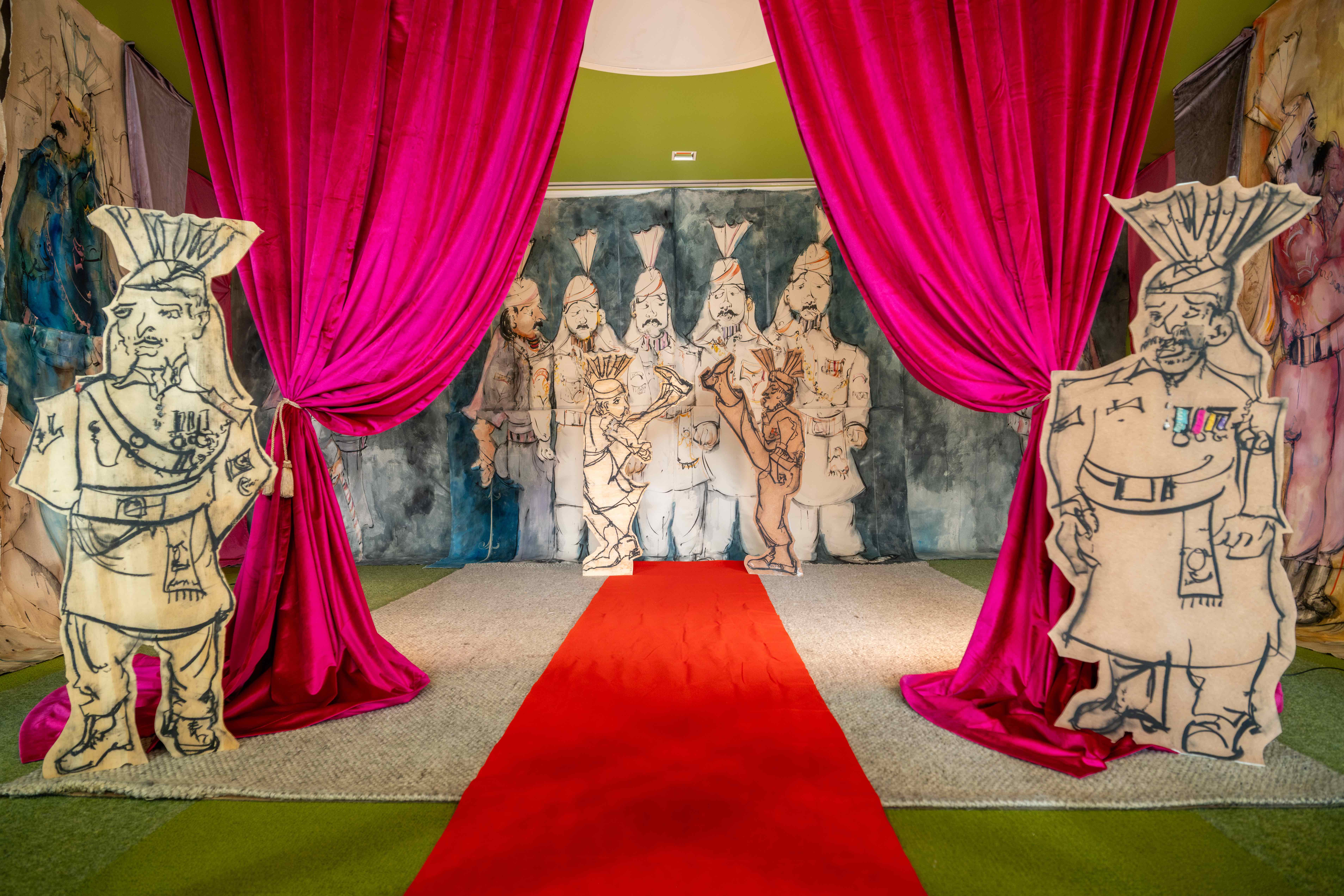
Tired feet, retreating, 2024, Aiza Ahmed
Giorgia Alliata di Montereale
Giorgia Alliata di Montereale was born in Buenos Aires and currently lives and works in New York City. She finished law school before attending art school and has since focused on language, propositions, and alternative methodologies. Her projects unfold as time-based arrangements that are negotiated and performed within the existing parameters she engages with when approaching a space and a group of people. Photography functions as notation and register in her work; sequencing and archiving are activities at the core of her practice. More recently, she has been working as an artist duo with Ridwana Rahman, carrying out the UMARELL project.
“I conceive of art as a form of attention that is shared in a time-sensitive context. I propose ways to watch, ways to notice and ways to arrange given the possibilities. This unfolds through collaborations that sustain an open format. UMARELL is a time-based methodology where there are certain non-negotiables and the rest is negotiable. My collaborator, Ridwana Rahman, and I exercise it as an attitude toward art that we are committed to discovering together. “ Giorgia Alliata di Montereale
NOVEMBER CAPTURE, 2025, UMARELL
Daniel Castro
Daniel Castro (b. 1997, Bronx, NY) is a mixed-media artist who creates paintings, sculptures, and immersive installations informed by his New York City upbringing and Latino heritage. Daniel graduated with a BFA from SUNY Purchase in 2020, and received an MFA from Columbia University in 2025. Daniel is the recipient of the Liu Shiming Foundation Fellowship, Aaron and Betty Lee Stern K Fellowship, Dong Kingman Fellowship, and Provost Fund Scholarship – Visual Arts. Notable exhibitions include Around the Way at LatchKey Gallery, New York, NY (2023); (Sur)face at Chilli Art Projects, London, ENG (2023); Día y Noche at Sabroso!, Santurce, Puerto Rico (2025); and Daniel’s thesis exhibition with Columbia University at Wallach Art Gallery, New York, NY (2025).
“I am a multi-media artist interested in exploring themes of cultural identity, displacement and erasure within the context of the urban landscape. By way of combining painting and sculpture, my work breaks out of the traditional painting format, resulting in assemblages that propose painting as object. My practice is also characterized by a fascination with materials that blur the line between reality and artifice. I create hyperreal replicas of urban detritus such as concrete barriers, traffic cones, and various other objects that typically exist within construction sites around the city. These objects are inherently embedded with connotations of gentrification, authority, and masculinity. My work with clothing such as hoodies, sagging jeans, and sneakers, reframe these garments as symbols of identity and systemic scrutiny. The hoodie in particular, becomes the most loaded signifier in the work—a representation of both protection and perceived threat.” Daniel Castro
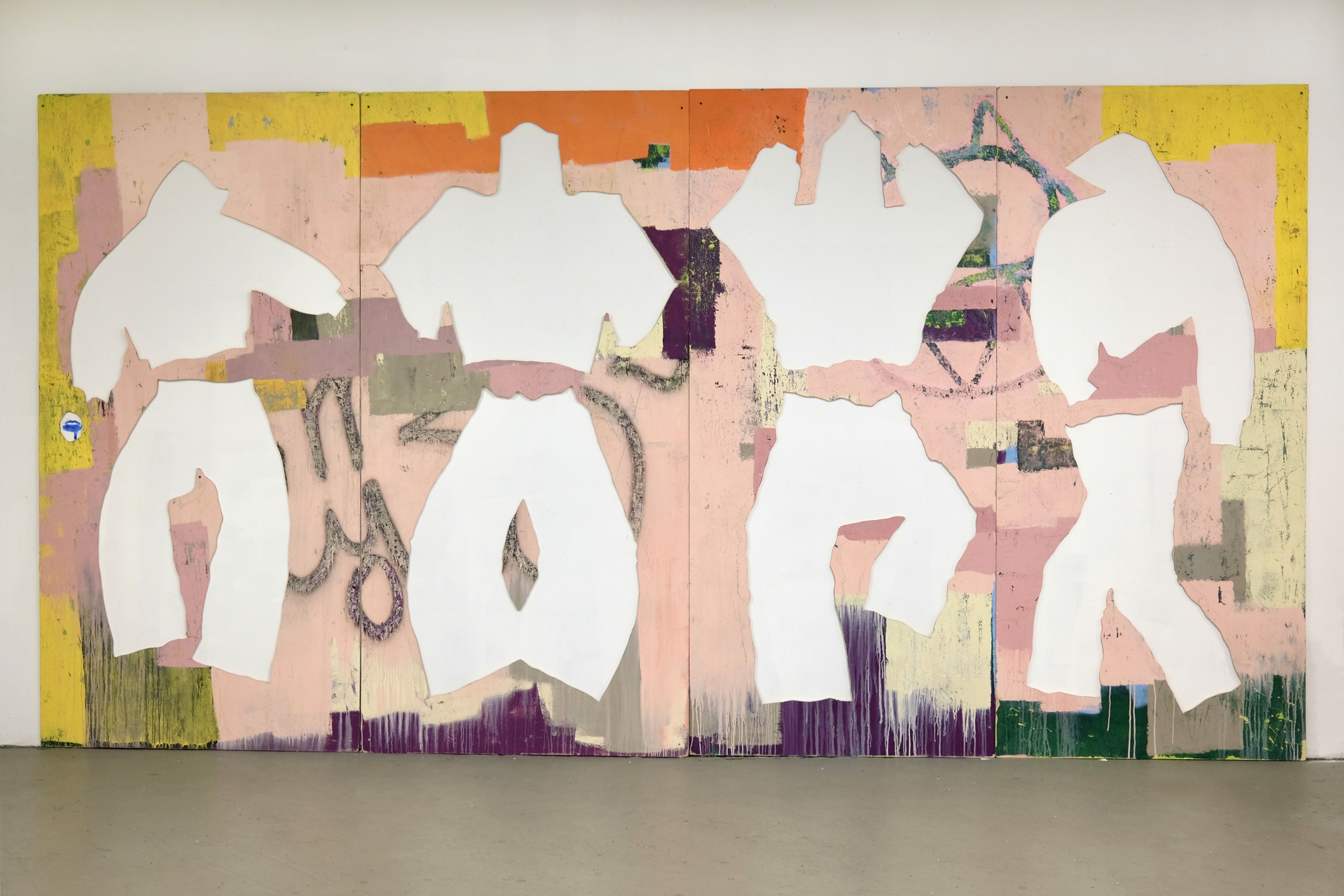
Memory Lane, 2025, Acrylic on plywood, Daniel Castro
Taína Cruz
Taína Cruz (born 1998 in New York) works across painting, drawing, sculpture, and installation to create experiences informed by personal memory and the worlds that shaped her. Recent exhibitions include Museum of Contemporary Art Detroit (2025); MMK Frankfurt (2025); Kraupa-Tuskany Zeidler, Berlin (2024); MoMA PS1, New York (2023); Kraupa-Tuskany Zeidler, Berlin (2023, solo); EMBAJADA, San Juan (2022, solo); Cruz received the Howardena Pindell Scholar Grant, Yale University, New Haven (2025) Alice Kimball English Traveling Fellowship, Añasco, Puerto Rico (2024) GO-A: Goya Opportunity Award, San Juan, Puerto Rico (2019) and was featured on the MICA Dean's List 2016-2020, Baltimore, United States of America (2020).
“Drawing from African American and Caribbean traditions, as well as the emotional landscape of growing up in New York, I build scenes where figures, objects, animals, and fragments of place carry the weight of past and present. My work holds an intensity that creates spaces holding tenderness, strangeness, and a sense of being alive. I move between tactile materials and digital sources, using the internet as another terrain of memory and intuition. I pay attention to how images, gestures, and the creatures that appear in my life return in altered forms, revealing what I keep close and what continues to shift.” Taína Cruz
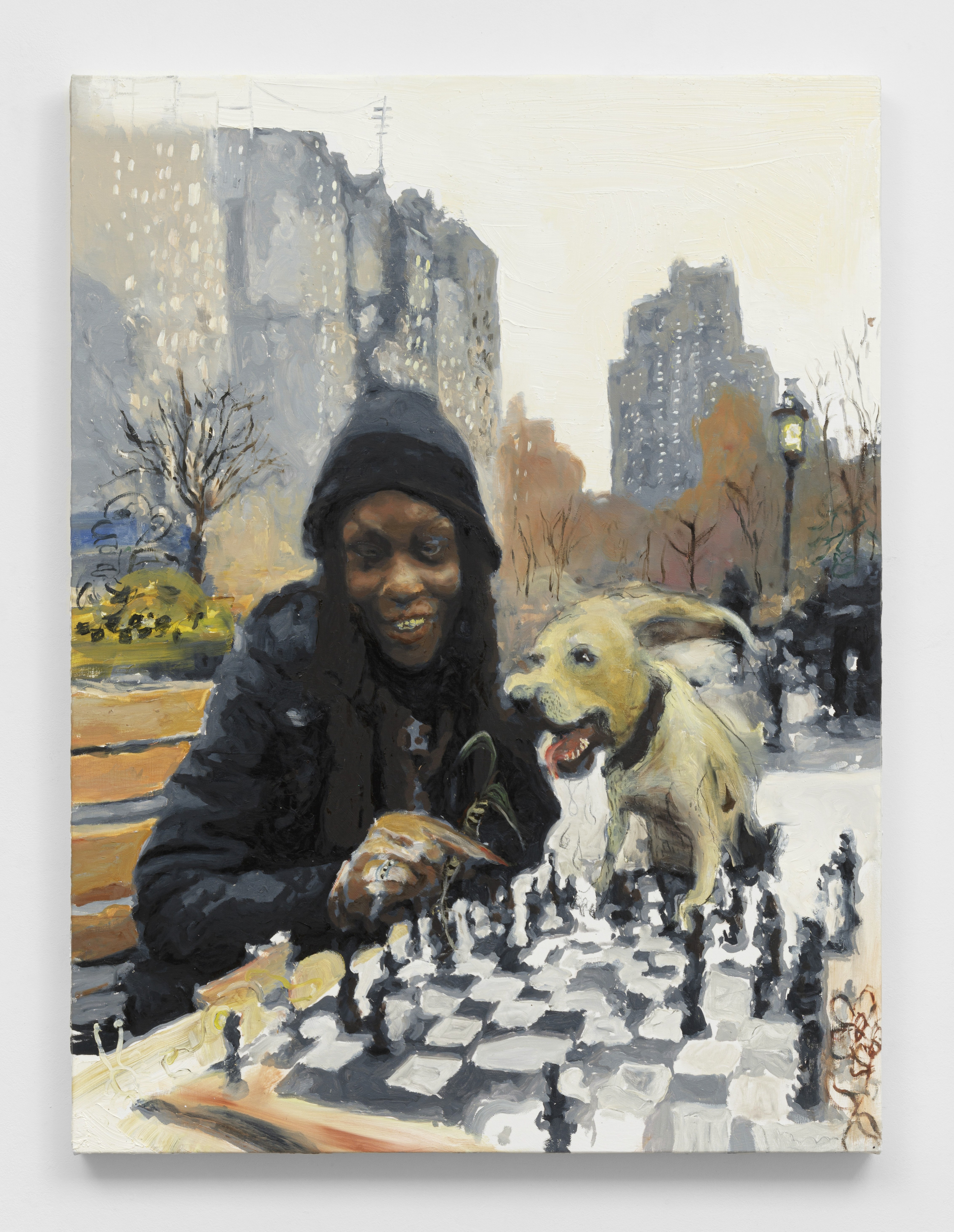
Root Check, 2024, Oil on canvas, Taína Cruz
Rachel Handlin
“I’m a large-format film photographer, filmmaker, screenprinter, lithographer, welder, sculptor, woodworker, storyteller.
In high school I started taking photographs of reflections, patterns, buildings, lines, symmetry. At CalArts, my mentor suggested I rephotograph someone’s work. I began rephotographing Eugène Atget using large-format film. Then I did things my way. I created kaleidoscopes—reflections, patterns.
I spend years on my projects. In 2015, I photographed a reflection in a scooter mirror in Paris. My mentor at CalArts said it was a nice photo, but what else is there? I kept going back, photographing more scooter reflections. The reflections break the background of the image—they interrupt. I interrupt a lot. What I want to say is more important. My 2019 show was Scooter Shots. My 2020 exhibition, Floraison, collected self-reflections I started in 2016. One professor said my images are a collection of time.
I learned to use a view camera. I made my negatives, contact sheets, working prints, and final prints in the darkroom. I made my color prints with the color processor. I still do my own printing in the darkroom. My photographs are a jumping-off point for lithography and sculptures. Crafting things by hand is important to me. Using my view camera, working in the darkroom, screenprinting, woodworking, welding sculptures are intense physical processes. I am the work. The work is me. First, my work told my story. Then, my series, le traget de l’âme, started telling somebody else’s story—my friend Brigid transitioning. I’m still telling her story, in platinum-palladium and sculptures. Last year, in strangers are friends I haven’t met yet, my photographs and sculptures told the stories of me and my friends with Down syndrome who have two or four-year college degrees—a community that didn’t know it was a community. I want to make people think about us. We are smart. Complicated. Interesting. All different. It’s social/political art, important for babies who haven’t been born yet. Society ignores us. We deserve opportunities. I want children with Down syndrome to get a good education like me. I see things other people don’t see. I make art other people cannot make.” Rachel Handlin
Untitled (from "Scooter Shots"), 2018, digital photography
Kristy Hughes
Kristy Hughes (b. Waxahachie, TX) creates vibrant abstract sculptures and paintings that reclaim agency, visibility, and joy through color, form, texture, and found materials. She transforms discarded and embedded objects into caring acts of resistance and preserved memory. Influenced by her Hispanic and Indigenous lineage, alongside formative experiences within fundamentalist religious institutions, her works are insistent on hope and repair––monuments for joy, care, and belonging. Hughes has been supported by fellowships at NXTHVN (New Haven, CT), The Fine Arts Work Center (Provincetown, MA), and Vermont Studio Center (Johnson, VT). She has been artist-in-residence at The Golden Foundation (New Berlin, NY), The Studios at MASS MoCA (North Adams, MA), Hambidge Center for Creative Arts and Sciences (Rabun Gap, GA), and Residency Unlimited (Brooklyn, NY), among others. In 2024 she was honored to be nominated for a Joan Mitchell Fellowship. Hughes earned an MFA in Printmaking from Indiana University and a MA and BA in Studio Art from Eastern Illinois University. Forthcoming and recent solo and group exhibitions include: Good Children Gallery (New Orleans, LA), James Cohan Gallery (New York, NY), Brandeis University (Waltham, MA), and The Sculpture Center (Cleveland, OH). Her work has been featured in Art Spiel, Shenandoah, Maake Magazine, and New American Paintings. She has a new public sculpture on view at The Aldrich Contemporary Art Museum in Ridgefield, CT through October 2026. Kristy lives and works in New Haven, CT.
“I am dead serious about joy and my work is an exuberant insistence on hope—an unapologetic reclamation of agency, visibility, and care. Through a process-based, materially exploratory practice, I make abstract sculptures and paintings that embrace conceptions of communal empowerment, joy as resilience, and hope as practice.” Kristy Hughes
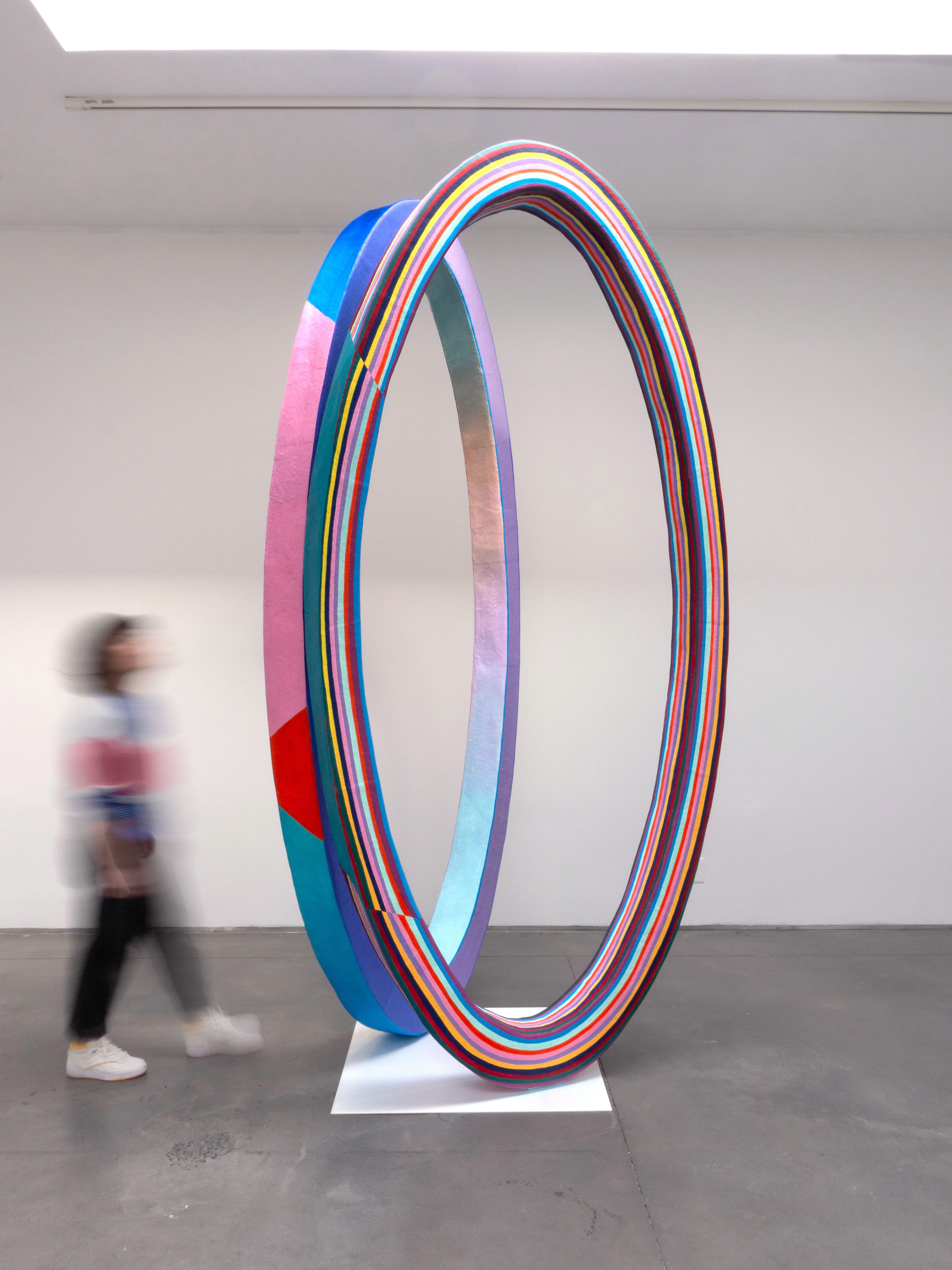
Portals, 2025
Acrylic, Steel, Wood, Insulation Board, Fiberglass, Aqua Resin, Handmade Paper Pulp, Notes and Poems on Paper Buried Inside the Sculpture
Sidian Liu
Sidian Liu is an artist whose work explores intimacy, reciprocity, and shared care across cultural and personal boundaries. Moving between Chinese and U.S. contexts, Liu creates participatory installations and performances that transform everyday encounters into spaces of connection. At Skowhegan, she crafted Can we share some time together?, a work using human hair spun into a broom to brush the audience while haircut conversations played, making tangible the tenderness of touch and trust. Other projects, like Are you from China? and Crystal Bubble Palace, playfully navigate identity, displacement, and fantasy through gestures of humor and empathy. Across works that span from cooking exchanges to collaborative photo projects, Liu reassigns agency and reveals the subtle dynamics of relationships, enacting Audre Lorde’s notion of the erotic as power to nurture collective care and possibility.
“I make relationships to explore how we can build trust and form intimacy from a respectful distance, the key step towards solidarity in this moment of isolation and division. Having grown up in a patriarchal and authoritarian culture that prescribes women to be submissive and self-effacing, I have been trained to master domestic skills from the age of four. After migrating to the US where care labor is predominantly shouldered by immigrants, I have continued to navigate between cultures and senses of belonging, while sustaining myself through forms of care work that society deems low-value yet depends on to function. I use these inherited “housewife skills” as artistic tools to reclaim agency, transforming gestures of care into acts of exchange and resistance. My work reconsiders what a woman’s labor can do: how it can gesture towards collective care and alternative kinship structures in which well-being is shared, not carried alone.
Living in flux as a resident alien from China, I work across images, performances, light-weight installations, and socially engaged projects –– portable, interactive, and relational. Throughout my work, I reassign one’s agency and reveal relational complexities, often sourcing support and participation from strangers, neighbors, or people who I haven’t met with a fearless openness, exploring how belonging can be made and shared with respect to differences.” Sidian Liu
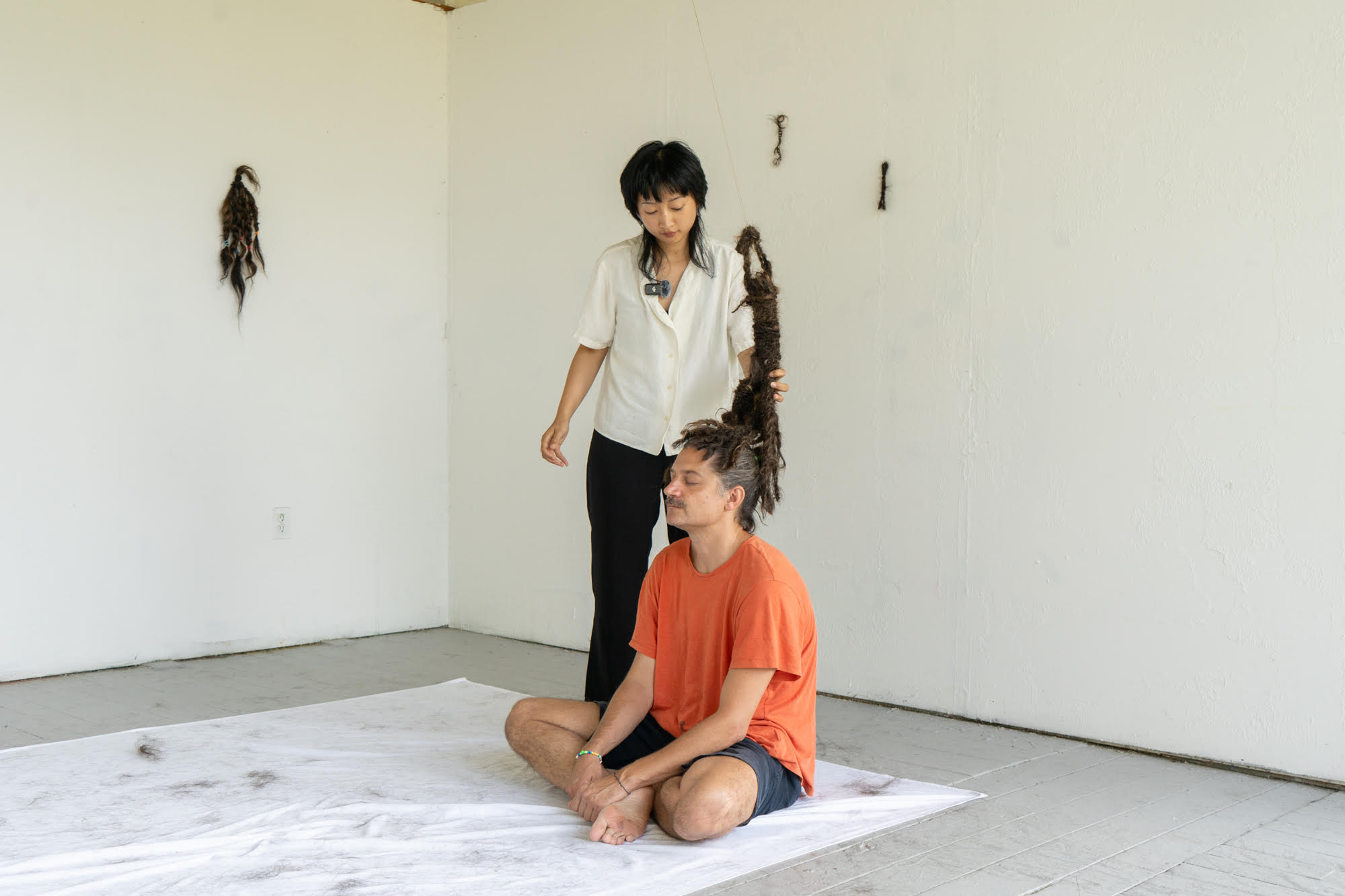
Can we share some time together?, 2025. Socially-engaged project, Sidian Liu
Haejin Park
Haejin Park is an artist from South Korea. She commands watercolor to archive emotions, a tender medium for exploring presence and absence. Blending abstraction with fragmented bodies, she paints complex narratives in bursts of color. She earned her MFA from Yale University and her BFA from the Rhode Island School of Design. She is currently a studio fellow at NXTHVN.
“Melting into watercolor, I feel complete. My undeniable smile comes from chasing a stain of prickling green flowering into forest purple. Color bleeds, nibbles, and bruises the substrate, while healing my inner state.
In magical delusion, home is a bipolar country where red abyss meets blue popular culture. My characters dare to riddle; how to reunite two colors. 38 lines echo in my mind, so I cast an eraser to smudge a border. We sing archives of emotion, fabricating our thoughts into a
bubble. A song called a Palette’s Dream, looking for a color beyond a rainbow. Behind the saturation lies the diaristic practice: a self-portrait that turns into a caricature. Brittle but blooming, a mother rests under the translucent shades. I layer my story and generational trauma from Korean War and my great-grandmother’s suicide. Women in my family’s shared pain and passion twist into a figurine. Her tears glitter, heavy with shame, drip down to a mouthless angst. She wrestles with loneliness, hallucinates spirits, and ultimately surrenders.
Painting is a reminder that life, even at its most warped, could be worth feeling. Every droplet scores intimacy and memory, fragile, just like a body in pain. Unapologetically expressive through colors, if one person cries and transforms the grief within, I am satisfied.” Haejin Park
One Last Rumble, 2025, Watercolor on Canvas, Haejin Park
Antonio Vidal de Lascurain
Antonio Vidal de Lascurain (b. 1996, Mexico City) is an artist who currently resides between New York and Mexico City. The elements of nature that appear in Vidal’s large-scale paintings emerge from catastrophe. Fires and floods intermingle with a vast visual repertoire that incorporates autobiography, biblical scenes, cave paintings, golem-like figures, mythological references, and something long foretold that has yet to happen. Vidal received his MFA from Columbia University, where he was presented with a Frankenthaler Award. He holds a Bachelor of Fine Arts in Painting & Drawing from the California College of the Arts, where he received a Creative Achievement Award (2016) and the Curator's Award (2020).
"Speculation is the motor of my practice. I draw from religion, shame, existing and fabricated mythology, personal narrative, speculative fiction, and ecocriticism. I use those elements to construct a universe that reflects primordial scenes and contemporary crises, both personal and collective: Narcissus surfaces, not in mythic springs, but in poisoned waters. Little societies flicker in and out of view—rising, falling, reforming. These future vestiges are parables that create a bridge between history and the future awaiting us. This temporal breadth also manifests in his painting process. Vidal applies several layers of acrylic paint, which he dilutes so that it slowly drips across the canvas, creating textures and densities that dissolve the boundaries between planes and bodies." Antonio Vidal de Lascurain
Arbol Ferris, 2025, Acrylic on Canvas, Antonio Vidal de Lascurain
Elzie Williams III
Elzie Williams III (b. 1993 Baltimore, MD) is a New York based interdisciplinary artist working in sculpture, collage, and installation whose work focuses on racial and social issues. He holds an MFA from Columbia University (22) and BFA from the Cooper Union School of Art ('15). Williams has exhibited at Art Lot Brooklyn (25), participated in group exhibitions at Canada Gallery, Half Gallery, New York, NY; C-L-E-A-R-I-N-G, Los Angeles, CA; M23, New York, NY and Francois Gebaly, New York, NY among others.
“As an interdisciplinary artist, my body of work combines sculpture, installations, and collage to address existing racial and social issues through the use of symbolism and allegory. Magazines in the U.S, depict "normal" American life, and that is not one of Blackness. Confused and simultaneously motivated by the content of magazines, I wanted to glean and merge the plethora of ads with the question of who is the consumer, and how the producer identifies with a young Black man. Flipping through thousands of magazines to locate, a single page that has one side depicting a face and on the other side a specific color. In parallel, I aim to bury and reconstruct the overt racial narratives that are told through these specific images. My goal is to expose underlying themes that have been built into images we consume and accept daily.” Elzie Williams III
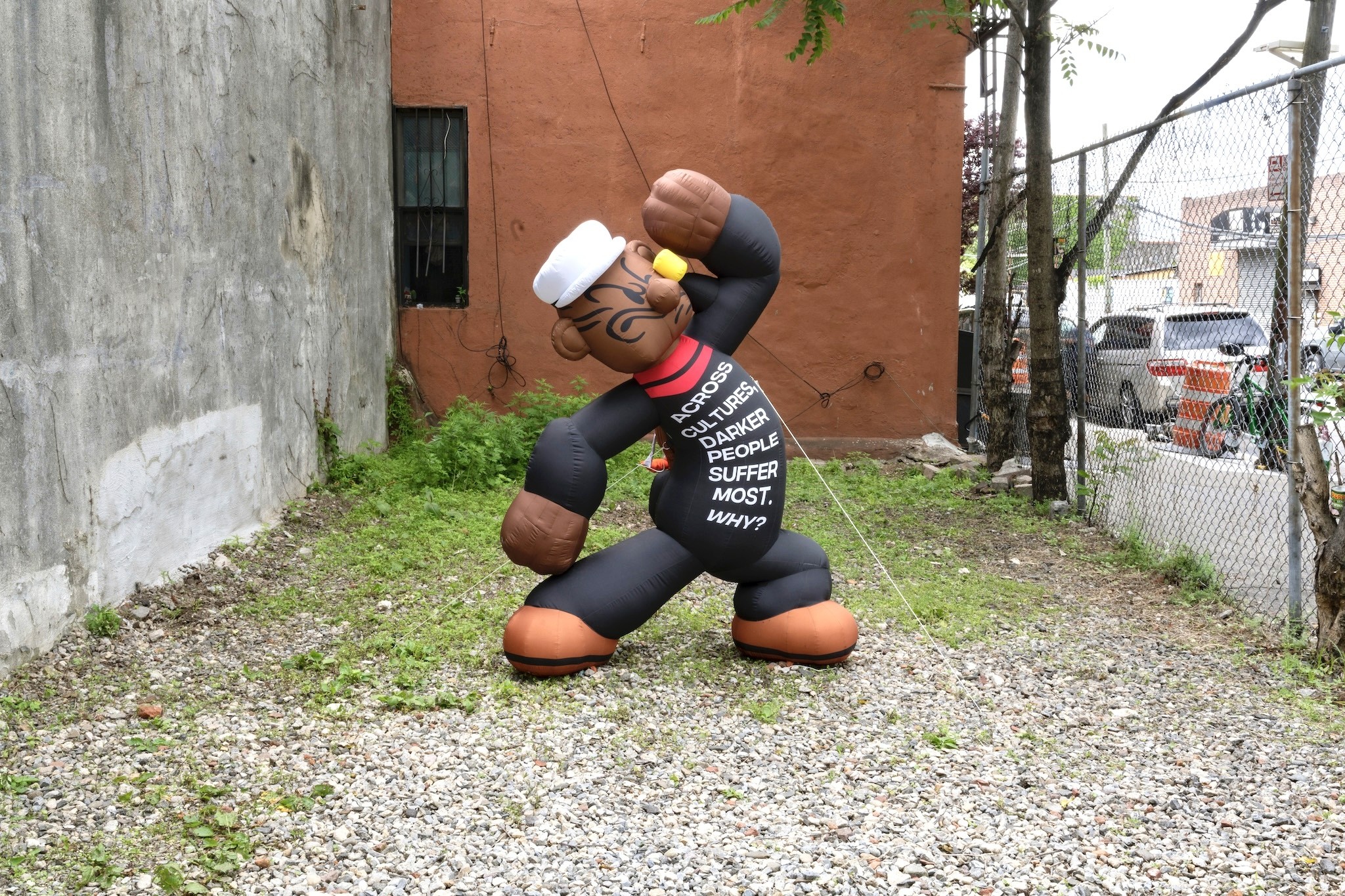
Popeye of The People, 2025, Custom inflatable, rope, garden stakes, Elzie Williams III
2025 Jurors
Augusto Arbizo is a Senior Director at Schwartzman&, New York
(2021–present), specializing in collector and artist advisory, sourcing, gallery relations, and curatorial collaborations. Lead S& Projects exhibitions, working closely with artists, institutions, and collectors to develop meaningful partnerships and innovative programming. Previously Partner at Van Doren Waxter (2018–2021) and Founding Director of 11R Eleven Rivington (2007–2017), focused on artist discovery, career development, and placing work with institutions and private collections.
Matthew Higgs is an English artist, curator, writer and publisher. His contribution to UK contemporary art has included the creation of Imprint 93, a series of artists’ editions featuring the work of artists such as Martin Creed and Jeremy Deller. During the 1990s he promoted artists outside the Young British Artists mainstream of the period. As of 2004, Higgs is currently director of White Columns in New York City.
Jamie Hort is a contemporary Art Consultant who advises clients on building and consulting private collections with their gifting and sales. She has been creating and building art collections for over 20 years, focusing on emerging and contemporary art. After graduating from the University of Vermont, Jamie earned her chops working at the Hirshhorn Museum, the Jewish Museum, and the IBM Gallery, volunteering her time to not-for-profit art organizations like White Columns and exploring independent and commercial films. For over a decade, Jamie has curated the installation of the Hort Family Collection and was previously named in Modern Painters magazine as one of the fifty “most exciting young collectors worldwide” under fifty.
Marcus Jahmal lives and works in New York. He was raised in Brooklyn’s Prospect Heights neighborhood, growing up in a family with roots in Puerto Rico and the American south. His paintings synthesize a diverse range of inspirations and autobiography, drawing from photographs, drawings, and hypothetical events. Jahmal's works move fluidly between genres spanning architectural interiors and still life, as well as landscape and portraiture. Developing his compositions directly upon the surface of each canvas, Jahmal coaxes imaginary, yet uncannily familiar, scenes to life, exploring themes encompassing dreams and folkloric Americana, and the contemporary realities of gentrification and city dwelling. As Jahmal explains, “most of [my] figures have a personality and a link to real life; I'm interested in a kind of filtered realism”.
Amy Smith-Stewart has organized nearly one hundred exhibitions across museums,collections, galleries, and temporary spaces. Her writing has appeared in books and catalogues published by institutions and publishers including the Bates College Museum of Art, Bemis Center for Contemporary Arts, Charta, Colby College Museum of Art, DelMonico Books, Gregory R. Miller & Co., KW Institute for Contemporary Art, MoMA PS1, Revolver Publishing, Rizzoli, Taschen, and The Aldrich Contemporary Art Museum. As both curator and writer, Smith-Stewart is a dedicated advocate for emerging and overlooked artists, as well as for erased and forgotten histories. She currently serves as the Diana Bowes Chief Curator at The Aldrich Contemporary Art Museum, where she has organized fifty-four exhibitions and projects since 2013. She launched Aldrich Projects, a series that presents a single work or focused body of work by a singular artist, and co-created The Aldrich Box, a program that commissions artists to produce original works designed to travel beyond the museum’s walls. Her visionary approach has brought artists to The Aldrich at pivotal moments in their careers, including solo museum debuts by Nickola Pottinger, Hangama Amiri, Genesis Belanger, Layo Bright, Milano Chow, Lucia Hierro, Michelle Lopez, Hayal Pozanti, Jessi Reaves, Eva LeWitt, Sara Cwynar, Chiffon Thomas, Elif Uras, B. Wurtz, and others. She has also organized major survey exhibitions with artists such as Martha Diamond, Harmony Hammond, Loie Hollowell, Raven Halfmoon, Karla Knight, Suzanne McClelland, Ruth Root, Frank Stella, and Jackie Winsor.